



For years, I described my work as community-led growth. I don’t anymore.
After spending time recently in rooms full of community practitioners, I’ve been thinking more carefully about how we describe this work. The language we use shapes how organizations structure authority, expectations, and accountability.
For a long time, calling it community-led growth felt accurate and necessary.
Community teams had spent years being treated as engagement programs orbiting the “real” work of go-to-market. So when the phrase gained traction, it felt like overdue recognition. It signaled business impact. It signaled ownership. It suggested that community wasn’t just supporting growth but driving it.
And in some cases, it did drive meaningful outcomes.
But over time, the language started to feel slightly misaligned with what I was actually seeing inside organizations.
Durable growth is rarely led by one function in isolation. Product doesn’t grow the company alone. Sales doesn’t. Marketing doesn’t. Customer success doesn’t. Each function controls a vertical slice of the lifecycle, and growth shows up when those slices reinforce one another.
So saying that community “leads” growth began to feel structurally imprecise.
Vertical companies, horizontal leverage
Most companies are vertically organized.
Product owns roadmap and prioritization.
Marketing owns demand and narrative.
Sales owns revenue.
CX or Customer success owns renewals and expansion.
Each function has clear authority and defined metrics. Accountability follows the vertical.
But community rarely maps cleanly to that structure. It gets placed somewhere on the org chart, but its impact doesn’t follow a single vertical line. That’s why it often feels awkward organizationally. It inherits goals that don’t fully reflect what it influences.
Uniquely, community operates horizontally.
It spans awareness, adoption, expansion, and advocacy. It sees early curiosity before it shows up in marketing dashboards. It notices which customers are quietly becoming power users long before expansion conversations begin. It hears friction before churn metrics move. And it captures the language customers use with each other when no one from the company is steering the message.
Years ago, when I explained community in stakeholder meetings, I’d draw the core GTM teams as vertical pillars and sketch community as a horizontal layer connecting them, supporting and informing each one.
That picture still holds up.
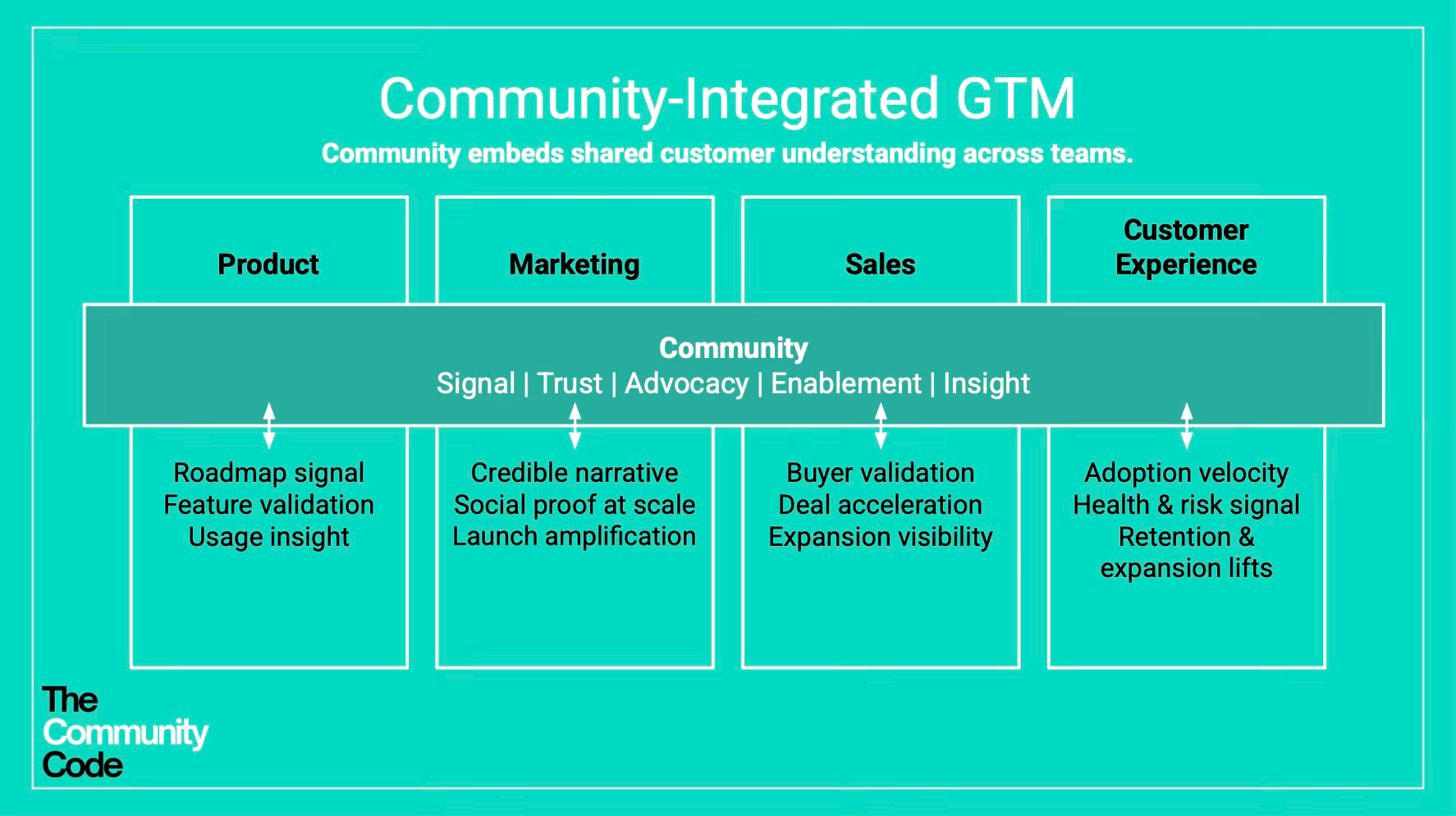
Community connects and integrates across pillars. It doesn’t lead or replace them.
Where “community-led” overcorrected
The issue with “community-led” isn’t intent. It’s structure.
The word “led” implies authority over outcomes and decisions. Inside most organizations, community doesn’t have that authority.
What it has is insight and influence without formal control. It can surface signal, generate advocacy, highlight friction, and create momentum. But the levers that convert those inputs into measurable outcomes still sit inside other teams.
When companies adopt the language of community-led growth, expectations rise quickly. Community is asked to drive pipeline, strengthen retention, increase advocacy, surface product insight, and deepen engagement. At the same time, product still owns prioritization, marketing still owns messaging, sales still owns revenue targets, and customer success still owns expansion and retention.
So what happens to community? Responsibility expands. Authority does not.
I’ve experienced that directly. I’ve also seen a related pattern inside larger organizations.
As companies grow, they sometimes create multiple community teams across verticals. Marketing builds a brand community. Customer success builds a customer community. Product builds a beta group. Developer relations builds its own ecosystem.
Each one reports into a different vertical leader. Each one is measured against different goals.
From the inside, it feels logical, because each community program maps to what their part of the org chart is trying to achieve.
From the customer’s perspective, it’s fragmentation.
The same customer ends up navigating multiple community experiences owned by different teams, each optimized for its own metric. That’s vertical thinking applied to something customers experience horizontally.
Calling any one of those efforts “community-led” doesn’t resolve that tension.
What community was actually doing
There are moments when community genuinely feels like the tip of the spear.
At Asana, community programs helped us expand into new markets. Champions drove internal adoption inside teams. Certified partners extended our reach into customers we couldn’t directly serve. Community surfaced friction in adoption long before it showed up in executive dashboards.
But community wasn’t operating in isolation.
It strengthened product decisions. It strengthened marketing credibility. It strengthened sales conversations. It strengthened expansion.
It amplified what the system was already trying to achieve.
Introducing community-integrated GTM
What I’m calling community-integrated GTM is a model that reflects how organizations function when they’re working well.
Community’s real leverage unfolds in three layers. They build on each other.
First: Alignment.
Community surfaces live customer signal across the lifecycle. When that signal is visible across product, marketing, sales, and customer success, teams stop optimizing against slightly different versions of reality. Alignment isn’t about agreement in meetings. It’s about shared inputs.
If marketing is telling one story, product is building for another, and sales incentives pull in a third direction, community engagement won’t compensate for that drift. Shared signal is the starting point.
Second: Integration.
Signal has to be embedded into decision loops. It needs to show up in roadmap discussions, positioning reviews, enablement materials, onboarding design, and expansion strategy. When community insight lives in a quarterly recap deck, it remains peripheral. When it’s part of how decisions get made, it shapes outcomes.
This is where many organizations stall. They gather insight but don’t restructure how they act on it.
Third: Amplification.
When alignment and integration are real, community strengthens what already works. Marketing claims are reinforced by visible customer momentum. Product bets are informed by active user behavior. Sales conversations include credible proof. Customer success can plug customers into peer networks instead of solving everything one-to-one.
Amplification is what people notice. Integration is what makes it durable.
What this changes inside a GTM organization
This reframing doesn’t mean community stops working toward shared goals.
Community should absolutely tie its impact to what matters most to the business at any given time. Pipeline. Activation. Retention. Expansion. Whatever the organization is optimizing for. That’s how credibility gets built. That’s how the dots get connected.
But community’s true impact doesn’t come from owning those outcomes in isolation. It comes from shaping how the vertical teams pursue them.
When community is integrated, product decisions are informed by live user behavior. Marketing messaging reflects how customers actually describe value. Sales conversations include credible proof from engaged users. Customer success can shift from reactive support toward peer-driven momentum.
Community works toward shared goals. It just does it through a horizontal lens that no other function has.
When organizations expect community to behave like another vertical team, they measure it narrowly and eventually split it apart. You see this in larger companies where multiple community teams emerge across different departments, each reporting into a different leader and each optimized for different metrics. Marketing builds one experience. Customer success builds another. Product builds its own. Developer relations builds a separate ecosystem.
From inside the org, it feels aligned to structure. From the customer’s perspective, it’s fragmentation.
That’s vertical logic applied to something customers experience horizontally.
Designing for community-integrated GTM means tying community to shared outcomes while protecting the horizontal vantage point that gives it leverage in the first place. Product, marketing, sales, and customer success still own their vertical goals. Community influences how those goals are pursued by strengthening the links between them.
Most GTM failures aren’t dramatic collapses. They’re slow misalignments. Teams operating from slightly different assumptions about the customer. Messaging drifting from roadmap. Sales optimizing for a slightly different definition of value than product intended. Small disconnects that compound quietly.
Community, when integrated intentionally, is positioned to see that drift early and influence correction across functions.
Over time, the shift shows up in how decisions get made across teams. That’s where durable advantage builds and compounds.
This is one of the core ideas behind my upcoming book, The Community Code, which comes out April 1.
Decoded Takeaways
Community-led growth elevated the role of community, but it didn’t fully account for how vertically structured organizations distribute authority.
Community’s leverage is horizontal. It influences product, marketing, sales, and customer success while still tying its work to shared business goals.
Community-integrated GTM builds in sequence: align around shared customer signal, integrate that signal into decision loops, then amplify what works.
When community strengthens the links between vertical teams and reduces cross-functional drift, it becomes a force multiplier across the entire go-to-market system.
Durable advantage comes from how coherently the system operates over time.